Wednesday, March 6, 2013

On The Road


I would not have published a new post so soon after the one yesterday except for the fact that I promised some new friends their photograph could be seen today on my blog.

This was a day of travel.  I drove from NADA Hermitage near Crestone, CO to Durango, CO.  My first stop was in Alamosa as I had hoped to make connections with a friend.  This did not work out.  I was feeling a bit lonely so decided to stop at a local coffee shop.   As I was walking toward Milagros Coffee House in downtown Alamosa, a group of college-age young people piled out of two vans.  One of them smiled and greeted me.  

We quickly learned that we were all from Michigan.  This was a group of students on spring break from Western Michigan University.  They were in Alamosa volunteering at LaPuente, a regional non-profit organization working with the disadvantaged.  

What a small world!  And that isn’t all.  The friend whom I was hoping to visit but who was unavailable is the director of LaPuente.  If he had been available I would not have met these eleven wonderful and cheerful young people.  I attribute this “happening” to God’s providential care.  Thanks be to God.

Peace and Love.

Larry

Larry met these wonderful students at Milagros Coffee House in downtown Alamosa, Colorado.   They are students at Western Michigan University and were volunteering at a local non-profit organization (LaPuente) during spring break.  At least two of the students are from the west side of the state.  One student is from Norton Shores and another is from Fruitport.
Larry stops for a rest at Wolf Creek Pass east of Durango, Colorado.

I made this photograph west of Wolf Creek Pass in the San Juan Mountains.

Same location as above.

Tuesday, March 5, 2013

Seeking the Presence of God


SEEKING THE PRESENCE OF GOD IN THE CITY, 
IN THE MOUNTAINS AND IN THE DESERT


Much has happened since I last posted to this blog three weeks ago.  I would like, through photographs and excerpts from my journal, to give you a glimpse into some of those experiences.  I realize that this post is more like a diary (what I did when and where) than a journal (self disclosure of what God is doing with and in me). In a future posting I plan to share more about the latter.

Since returning to the United States from Haiti on February 6, I have lived in the city, in the mountains and now in the desert.  I have discovered, for me, that each environment has its own unique appeal.

THE CITY

I flew into Denver International Airport where I was warmly greeted by my daughter Susie and her step son, Jeremy.  I stayed with Susie, her husband Mike, and Jeremy for ten days.  We all celebrated my 76th birthday with some of Susie’s biological family from the Denver area. 

On Sunday we attended mass at the Cathedral Basilica of the Immaculate Conception.  This majestic, 102 year old, cathedral is the seat of the Archdiocese of Denver of the Roman Catholic Church.  Its architectural design is French Gothic Revival.  There are two 210 foot spires.  The building is made of limestone and granite, whereas  the altar, statuary and the bishop’s chair are marble.  There are 75 beautiful stained glass windows.

The Cantor sang liturgical solo passages to which the choir and congregation responded.  The cantor’s voice was so pure and awe-inspiring.

The congregation is heavily involved in meeting the needs of the homeless.  One of its ministries is serving 60,000 meals yearly to the poor in downtown Denver.  


THE MOUNTAINS

I then traveled 200 miles to the west to visit St. Benedict’s Monastery in Snowmass, CO.  This community consists of a group of 17 monks and priests. They are of the Cistercian Order commonly known as Trappists.  
The monastery is located on 3800 acres and sits between the ski resorts of Aspen and Vail.  The spectacular valley, at 8,000 feet altitude, is surrounded by the Rocky Mountains.

Guests are invited to join the members of the monastic community at three liturgies daily.  I attended several of them.  They are:
4:30 am-Vigils
7:30 am-Lauds and Mass
7:00 pm-Vespers and Compline

During the Vespers, 17 white-robed monks, sitting facing one another in the choir, chanted and sang prayers. Scripture was then read after which the lights were turned out.  While the candles flickered, we were ushered into silence and stillness for about ten minutes. 
The retreat facilities, sitting separately from the monastery by 1/2 mile, were designed and built to foster the spirit and practice of silence, solitude, meditation and prayer as a
means to deepen one’s spiritual life.  

Guests are accommodated in four guest rooms and eight separate hermitages. Each place includes a full kitchen and bath and each has a view of the mountains (Mt. Sopris is the most impressive).  Each guest supplies and prepares one’s own meals.

All guests who present themselves are to be welcomed as Christ, for He himself will say, “I was a stranger and you welcomed me.
Rule of St. Benedict

While most of my time at St. Benedict’s Monastery was non-directed, I was invited to participate in a “Morning of Centering Prayerwith the Contemplative Outreach of Colorado.  The focus of Centering Prayer is the deepening of our relationship with the living Christ through simply resting in God beyond thoughts, words, and emotions.  Father Thomas Keating, a member of this monastic community, is one of the leaders in the centering prayer movement.  He has written extensively on it.

About 60 people participated in this morning of silent prayer.  The time was divided into eight, 20-minute Centering Prayer periods.  Prior to participating in these sessions, I attended a talk on “Introduction to Centering Prayer. “ 

Although the practice of Centering Prayer had been important to me in my early faith journey, I have not been practicing it lately.  It felt so good and right to be with a group that puts a very high value on this form of prayer. With God’s help, I plan to practice this form of prayer daily (or twice daily as recommended by the ‘experts’).

“Centering Prayer is a method designed to facilitate the development of Contemplative Prayer by preparing our faculties to receive this gift.  It is a movement beyond conversation with Christ to communion with Him.”  
The Prayer of Consent, Thomas Keating

THE DESERT

Therefore I am now going to allure her; 
I will lead her into the desert 
and speak tenderly to her.   Hosea 2:14 NIV

From the mountain environment I traveled south to the desert.  I had a reservation to spend two weeks at Spiritual Life Institute’s hermitage.  This monastic community is situated at the base of  the breathtaking beauty of the Sangre de Christo range of the Rocky Mountains, just outside the village of Crestone, CO.  Several 14,000+ snow-covered peaks are visible from my window.

This was a homecoming for me.  From 1968-1970 our family lived in San Luis, a small town of largely Hispanic-Americans, located 70 miles south of Crestone.  We served in the clinic under the Presbyterian Medical Services of the Southwest.

This hermitage is a Roman Catholic ecumenical community of vowed men and women with roots in the Carmelite contemplative tradition.  As described in their quarterly journal, Desert Call, Contemplative Christianity and Vital Culture, the community “aspires to create a vital environment characterized by solitude, simplicity, and beauty, where community thrives, love is nurtured, prayer flourishes, and the whole person can be transformed.”  

This hermitage is one of two hermitage retreat centers of the Spiritual Life Institute.  Their other center, Holy Hill Hermitage, is in Ireland.  NADA is located on 1,000 acres of desert.  It consists of a central building, which houses a large library, offices and kitchen.  There is also a chapel, where services are held several times a week.

The members of the community take seriously God’s command, “Be still and know that I am God.” (Ps. 46:10)
Brother Thomas, during a liturgy, prayed, “Father God, may we love you as no other person has ever done.”  I took this as a most worthy challenge, while realizing that this depth of love could only be achieved through a gift from the Holy Spirit.

During this retreat I am again surrounded by solitude, silence and stillness for most of the time.  I have discovered these three “S’s” are essential for my spiritual growth and well-being.  This type of environment facilitates my sense of being in the presence of God like none other. Upon returning to the real world in a couple of months, I will want and need to incorporate intentional times of the three “S’s” into my daily life.

Guests are housed in separate, 400 square foot hermitages.   NADA provides basic foods including: grains, cereals, cheese, bread, coffee, tea, fresh vegetables, fruit, canned goods, etc.  Guests cook for themselves.  Each Sunday after mass, the guests are invited to join the monastic community at breakfast.  Guests can stay from a weekend up to a year.  The usual stay is for one week.  Tomorrow I will have finished my two weeks. 
This community is very environmentally conscious.  My hermitage is covered by earth on the north side.  Large windows on three sides allow solar energy to passively heat the interior. There is a majestic view of the Sangre de Cristo mountains to the east. To the south is a view of The Great Sand Dunes National Park.  One can see the San Luis valley and the San Juan mountain range to the west. There is a small, well-equipped kitchenette, a bedroom, an office space, a living room and a bedroom.  There is a wood stove, which I use early each morning to take the chill off.

Upon leaving the hermitage on March 6, I plan to travel in my minivan south to Arizona.  I hope the weather is warmer.  There, in addition to visiting friends and relatives, I will be staying at two different retreat centers near Tucson.  I also hope to do some tent camping in the desert.

Grace and Peace.

Larry Braak

(Please excuse the incorrect order of photographs.  I am still working on it.)

“Enlightenment is an accident.  Meditation makes you accident prone.”
Found scribbled on the front page of Spiritual Life Institute library’s copy of Henri J. M. Nouwen, Encounters with Merton.

Larry and daughter Susie celebrate Larry's 76th birthday at her family's home in Commerce City, Colorado.

The chapel at Spiritual Life Institute Hermitage serves the monastic community as well as worshippers from the nearby town of Crestone, Colorado.

The Cathedral Basilica of the Immaculate Conception is the seat of the Archdiocese of Denver of the Roman Catholic Church.  The interior is largely made of limestone and granite.
The interior of Larry's hermitage at Spiritual Life Institute is largely heated by solar energy.  A wood stove serves as a backup during chilly mornings.  The hermitage is well equipped and has a kitchenette, bathroom, bedroom, office space and living area.

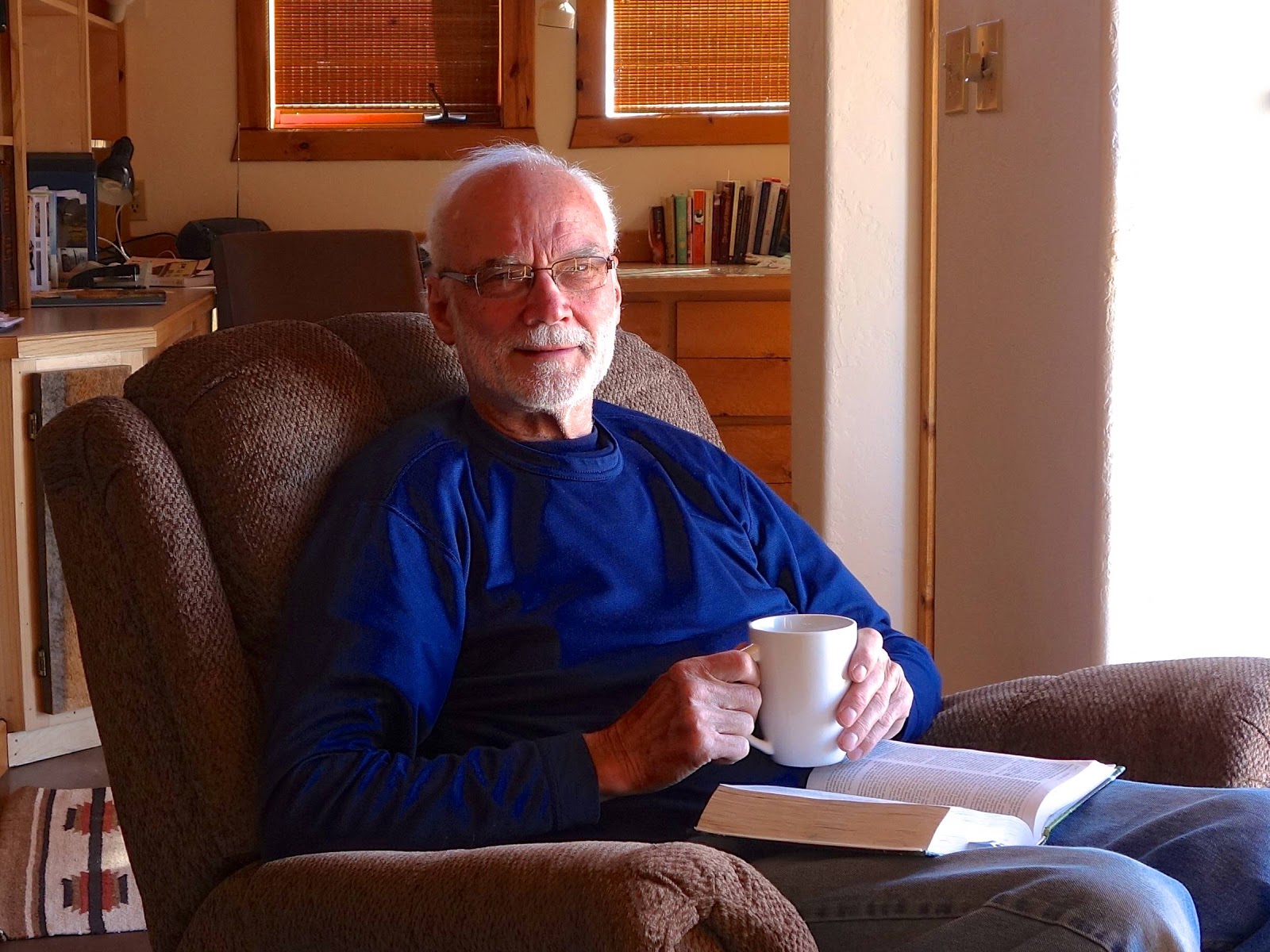
Larry enjoys holy leisure in his hermitage at Spiritual Life Institute.

Larry's hermitage at Spiritual Life Institute is in the foreground.  The Sangre de Cristo Mountain range of the Colorado Rocky Mountains is in the background.  In the center is Kit Carson Peak which reaches over 14,000 feet in height.

St. Benedict's Monastery is situated in a majestic valley in Snowmass, Colorado.  Larry spent a weekend here learning "Centering Prayer."

Mule deer enjoy an early morning stroll just outside of Larry's hermitage at Spiritual Life Institute. 

Nada Carmelite Hermitage is one of two hermitages of Spiritual Life Institute.  The other hermitage is located in Ireland.  "Nada" in Spanish means "nothing".  This is taken from one of St. John of the Cross's favorite sayings, "There is nothing but God."  The San Luis Valley and the San Juan Mountains are seen in the far distance.

Larry, on left, views the Sangre de Cristo mountains with Brother Thomas, who is a member of the hermitage's community of monks.  This cabin is part of the Nada Carmelite Hermitage.  It is located high in the mountains above the main group of buildings.  The cabin is available for those who desire utmost privacy. 


Friday, February 8, 2013

Gallery of Haitians

Dear Friends,

As I have previously shared, part of my reason for traveling to Haiti this season was to document with my camera the life of the people who live in the mountains surrounding the Artibonite Valley.  In this posting are some of the photographs of these Haitians.  Enjoy!

Blessings,
Larry

Farmer Nacis Saintet


Friend of one of the gardeners whom FIAI has been helping.

Eritane Tirus

Pastor Gustin Enadieu

Rosemitha Asainvil

Tortor
Ficilta's uncle, Odamis 

Ficilta's cousin, Mishna, is cooking blood pudding in the kitchen. 
Wawa and Lolo 
Wud, Wisner and Denden are Ficilta's cousins.


Sunday, February 3, 2013

  Ficilta Braak's mother, Marie Denise Philius, scrubs pots and pans after dinner.


 I take a self-portrait in a mirror in the Philius home.


Inoson uses his machete to debark and square a log.  In background, on right,  Ficilta's father, Oleus Philius, holds his machete during a brief rest break.  Oleus often volunteers to help neighbors build their homes.


Marie Denise boils the head and legs of the goat carcass which process assists in the removal of hair.  Oleus is skinning the goat carcass in the background.  In order to be ready for the market by 8:00 a.m. the couple must begin this process at 5:45 a.m.  This all takes place in the courtyard of their home.  Behind Marie Denise is the kitchen building.


Oleus builds a table which will be sold at the market.

As the sun heralds the beginning of a new day, Marie Denise is helped by cousin Michlet in the removal of fine hairs from the goat carcass's head and legs.

Marie Denise offers all parts of the goat carcass for sale in the market.

Ficilta's younger sister, Joane, prepares a delicacy from the goat's blood.  She adds garlic, basil, lime juice, and green onions to the kettle.  Joane is concocting this in the kitchen.
Dear friends,

During the past several days I had the distinct privilege of hanging out with Ficilta's family as they went about their daily lives. I will be ever grateful to them for giving me this unique opportunity to observe and document, with my camera. a typical mountain family.  Her parents live in a small home in the mountains above the village of Verrettes.

I particularly was fascinated by how Ficilta's parents, Mr. and Mrs. Philius, worked in concert as they carried out the many tasks culminating in the sale of goat meat at the market.

I apologize for not having the photographs in the proper sequence.  I am still in the process of learning how to produce a blog.

Tomorrow I fly to Denver, CO.  I have thoroughly enjoyed being a guest for the past five weeks at son Tom, Ficilta, and Ryan's home in Verrettes, Haiti.  For the next week or so I will be a guest of daughter Susie and her family in Commerce City, CO.  After my visit with them, I will check into a monastery and then a hermitage in Colorado.

Blessings,

Larry

Wednesday, January 30, 2013


 Tom Braak Speaks at Annual General Conference of Methodist Church of Haiti

January 27, 2013  

Dear Friends,

Tom had been invited by The Reverend Bishop Paul Gesner to address the Annual General Conference of the Methodist Church of Haiti to be held in Jeremie (see map), from Jan. 21 - Jan. 26, 2013.  Tom was to familiarize the attendees about Faith In Action International and to invite them to consider possibilities of the Methodist Missions of Haiti to join forces with FIAI.

Jeremie had once been the cultural center of Haiti.  Many of its residents were writers, poets and artists.  I was informed that this group, and its families, were massacred by Papa Doc when he heard that they were forming an uprising against him.  

This town is only 45 minutes away by plane from PAP.  As the flights were filled, Tom’s only recourse was to drive.  The estimated driving time would be 15 hours.  Some of the road would be over two mountain passes.  Tom invited Jean Rony and me to ride along with him.

We started from Verrettes on Jan. 22nd at 6 am.  We arrived in Les Cayes at 4:00 pm.  Tom had planned to visit SEED, a thriving nondenominational mission in Les Cayes.  SEED consists of a school where students, after three years of intensive academic and field work, complete combined studies in agriculture/animal husbandry and theology.  

The current student population is 95. The mission was founded and is directed by the Reverend and Mrs. Frantz Clotaire.  We were impressed by both the vigorous training provided the students as well as by the conscientious daily care that the students give to their assigned gardens.  We met several of the students as they began tending their gardens at sunrise on Jan. 23rd. The students work in their gardens from 6:00 a.m. until noon, after which they attend classes until 6 p.m.

The Clotaires graciously invited us to stay overnight in SEED’s guest house.  We gratefully accepted their invitation.

Tom has a vision that FIAI will someday hire several of SEED’s graduates.  I believe these students, with their blending of knowledge in agriculture and theology, could become a vital part of FIAI’s mission.

By 11:00 am we started up the mountain road toward Jeremie.  As the road turned from being wide and paved to being narrow and graveled, I prayed that the old Mitsubishi 4-wheel drive truck would hold together.  We averaged 7 m.p.h. over the bumpy, rocky mountain passes.  The scenery was awe-inspiring and breathtaking. The mountains were lush with semi-tropical vegetation.  This was so different from the barren mountains near Verrettes.  The dusty roadbed  turned from a dull bedrock grey to an intense deep red.  As we passed through mountain villages, Tom, with the window open, would call out his proverbial greeting, “Bonjou” (good morning), “bonswa” (good afternoon), “koman ye” (how are you) to everyone along the way.    The passersby, in turn, would smile and call out “nou byen.” (we are fine)

After we drove 5 five hours we came upon a stunning mountain view of Jeremie.  The city lie before us with the intense emerald/blue Caribbean Sea as a backdrop. Upon arrival in Jeremy an hour later we checked into a hotel. 

The next morning, Jan. 24, we drove to the Annual General Conference of the Methodist Church of Haiti.  There we learned, with considerable disappointment, that Tom’s presentation had not been included in the packed six-day schedule.  Tom also had planned on using a PowerPoint presentation-but there was no equipment available. 

During the lunch break, Tom approached Bishop Gesner.  The Bishop said that he would try to work Tom into the schedule sometime within the next few days, but there was no guarantee. 

By God’s grace, Tom was called upon by the Bishop right after the meeting reconvened.  Tom addressed the delegates in Creole.  The audience listened with rapt attention. Jean Rony and Tom answered several questions during Q & A. 

The fruition of the presentation is in God’s hands.  In attendance, in addition to the 90 delegates and the Haitian Bishop, was Bishop Scott Jones of the General Conference of Arkansas/Kansas.  His General Conference has a special interest and involvement in missions in Haiti.

By 2 p.m. we were back on the mountain road to begin our return to Les Cayes.  It soon started to rain, which turned the road into a combination of slippery rocks and mud.  At one point as we were ascending a steep grade with a deep ravine on our right, the truck, although engaged in four-wheel drive and low gear, slid backwards.    Jean Rony, who was driving, successfully repositioned the truck after which we managed to slowly move upward and forward. 

After this scary experience we loaded three boulders into the truck bed.  With this extra weight, the truck gained adequate traction.

We drove five hours and arrived safely in Les Cayes.  As the SEED Guest House had already closed for the day, we found a reasonably-priced hotel.  Upon checking in we were graciously offered cocktails ‘on the house’.  We also enjoyed an unexpected but welcomed air-conditioned room.  

In the evening Jean Rony and I ate at the hotel.  I had chicken pizza.  J.R. ordered Haitian chicken.  Tom traveled downtown by motorcycle taxi to his favorite oriental restaurant.  Imagine-we enjoyed cuisine from Haiti, China and Italy!

Following breakfast the following day, we left for Verrettes.  As we entered PAP, the capitol and the largest city of Haiti (population 3 million), we were waved down by two men.  Our friend Obenis and his brother, Obes, had taken the bus earlier in the day to PAP to obtain a driver’s certificate.  They were waiting for a bus for their return trip to Verrettes when they saw us.  We were thrilled to see one another.  

We all went for lunch.  After Tom did some shopping, we heard that the road through St. Marc was blockaded by men who were protesting foreigners living in Haiti.  This demonstration erupted after a Haitian motorcyclist was hit and killed by a United Nations truck.  We had no choice but to return to Verrettes on a mountain road which circumvented St. Marc.

About 6 p.m. it turned pitch black and started to rain.  We stopped in Mirabelais to purchase a tarp to cover our luggage in the truck bed.  Soon we came upon a motorcycle which had no headlight, tail light or reflectors.  What a dangerous situation!  We closely followed the cycle in order to provide light for the driver.   After 15 minutes the driver pulled to the side of the road.  We stopped to offer assistance.  We learned the motorcyclist was headed to St. Marc (another two hours).  The motorcycle’s headlight had died earlier and it had just run out of fuel.  The driver had no money and knew no one in the vicinity to ask for help.

The driver accepted our offer to take him to Verrettes where he hopefully could find a replacement headlight and fuel.  We loaded the motorcycle into the back of the truck.   Tom slipped him $20.

We thus completed three days of challenges and opportunities.  Several times we gratefully acknowledged God’s omnipresent guidance, wisdom and protection. 

This week Ficilta and Tom graciously invited me to stay with them for another week.  I gladly accepted.  This will give me not only more time to enjoy their wonderful family, but also time to make more photographs for my project of documenting the lives of Haitians who live in the mountains.  

In spite of several cell-phone connection interruptions, Tom was able to change my return flight ticket with American Airlines from January 28th to February 4th.

May God bless you with His peace and joy.

Love,  Larry


Tom's favorite oriental restaurant is in downtown, Les Cayes, Haiti.


Jean Rony, SEED's founder and director Frantz Clotaire, Tom Braak


Tom and Jean Rony talk with SEED student about the fields of lettuce and garbage.


Larry befriends a boar goat at SEED's animal husbandry project.


We approach beautiful Jeremie, Haiti which lies on the Caribbean Sea.  


Tom is introduced at the annual General Conference of the Methodist Church of Haiti.  Bishop Paul Gesner of Haiti and Bishop Scott Jones of the Nebraska/Kansas General Conferences are at the speakers' table.


Jean Rony and Tom address questions during Q & A.


A bus travels over a mountain pass toward Jeremie, Haiti


Tom and Jean Rony load boulders into the truck to provide greater traction on slippery mountain roads.


As we descend from the mountain toward Verrettes, we are greeted by the majestic Artibonite Valley.


Add caption
Jeremie lies at the extreme tip of the southwest peninsula of Haiti. 

Tuesday, January 22, 2013


“If I really believed what you believe, I wouldn’t get up from my knees.”  
Mahatma Gandhi in a talk to Christians

Dear friends,

I have been pondering that thought of Gandhi’s the past few days.  Back in the states I admit that my modus operandi is that of self-sufficiency.  Whenever I have lived in a country such as Haiti for a while, I must relearn that this method of operating does not work.  It may take me a few days-this visit it took two weeks-for me to radically change my modus operandi and recognize that I am weak and helpless but through the power of prayer, all things are possible.

My bodily posture literally changes-from being upright to be driven onto my knees by God in prayer.  

Haiti is beset with many troubles and each church mission has its own unique hurdles.  During my short visit, I have become intimately aware of and directly affected by the many hurdles that Faith In Action International and Tom’s family face daily.  This past week we have been strained with the the breaking down of both of FIAI’s trucks, illnesses of staff, obscure power plays by key people in another Christian mission that significantly affect FIAI, failure of storage batteries which FIAI depends upon for power, failure of propane oven and refrigeration ...to name a few.  

In the states many of these issues could easily be handled as there are resources available.  In Haiti resources are few and, when available, are located often many miles away.  For instance, the nearest fairly complete hardware store is in Port au Prince which is a three-hour drive.

Although I don’t believe that God causes these troubles, God uses them to arrest our attention; to awaken us to a sense of helplessness and weakness.  I think this is why I see more devout Christians in Haiti than I do in the U.S.  Haitians have learned to depend upon their faith in God for power to overcome their many challenges on a 24/7 basis.

God has shown Himself again to be faithful in providing very tangible resources:  An auto mechanic, trained in the United States, appears out of nowhere this week and offers his skills;  the owner of a tow trucking business from a neighboring town arrives last night at our door and offers to tow the disabled truck down from the mountain; a Floridian pastor and his wife, visiting relatives in Verrettes, stop by yesterday to use Tom’s exercise equipment and stay and pray with us; ...and the list of his mercies continues.

I believe that I know a little more now of how the wayward son in the Prodigal Son parable must have felt when he realized--having finally acknowledged his own weakness and rebelliousness--where his true home lay and returned on his knees in total submission to the Father.  I ponder why it takes me so very long to fully acknowledge this truth and to incorporate it into the depth of my being.

Love,

Larry


“And we know that all things work together for good to those who love God, to those who are called according to His purpose.”
Romans 8:28


Saturday, January 19, 2013

Photographic Highlights of Haitian Friends 

January 19, 2013

Veronie Derilus lives with her family in a mountain village.  She babysits for a friend.

Obenis Charlouidort, a high school student (on left) is a good friend of the Braak family and works part-time for Faith In Action International.  Annrik (Echo) is also a good friend.  He comes over to the Braak house almost daily to hang out.  He and Ryan enjoy playing games together.

Pastor Gustin Enadieu visits his parishioners Lemesia Pierre (left) and Asainvil Kettelie.  Jean Rony and Larry spent two days with the pastor making pastoral calls with him in his mountain parish.

Tom and Larry Braak made four pizzas from scratch for a surprise 21st birthday party for Limene.

Ficilta Philius Braak, Tom's lovely wife, is a superb hostess.

Mountain family pound millet to make meals.

Maricia Charlouidort is Mother of Obenis.  She buys corn wholesale and sells it retail in the market.

Charlouidort Onondieu is Father of Obenis.  He has been too ill to work in the fields.

Kathy, director of the preschool where Ryan attends, is a very creative and caring woman.  She brings a variety of experiences to the students.  She started the school eight years ago.

Pastor Marc Montunat and his wife Maria of Palm Coast, Florida visit Tom and Ficilta for Christian fellowship, prayer and hymns.  The Braak's home is a welcoming respite for many visitors to Verrettes. 

Tom treats us at a new restaurant in Verrettes following Ryan's first week at preschool.

Tom erected a security light on the home's roof.  Local vendors take full advantage of the light while sorting onions to sell the following day in the market.

Watson Charlouidert, brother of Obenis, and Ryan Braak enjoy each other.

Ryan attends preschool with these children.  He enjoys school.  They begin each day with singing.